
Binocular Basics – Understanding BAK4 vs. BK7 Prisms
By Telescopehubs Optics - 12/07/2026 - 1 comments
BAK4 and BK7 are industry codes for two different types of optical glass used in prisms. The key difference lies in their refractive index. BAK4 glass has a higher refractive index, allowing it to reflect 100% of the incoming light (excluding absorption losses). In contrast, BK7 reflects only about 83%. This makes BAK4 significantly more efficient in light transmission, though it comes at a higher cost. For this reason, BAK4 prisms are typically found in premium consumer optics and high-end spotting scopes.
Some enthusiasts often ask about the difference between Bak4 and BK7 prism materials. While it sounds simple, explaining it thoroughly requires a bit of depth. To keep things clear and manageable, this article will focus specifically on Porro prism binoculars.
Before diving into the comparison, let’s address why binoculars need prisms in the first place.
As most know, prisms in binoculars serve the primary purpose of erecting the image. They work similarly to a household mirror, flipping the upside-down and reversed image so that it appears correctly oriented to our eyes. Mirrors are straightforward—we understand how they reflect light. However, look at a prism: all its surfaces are transparent glass, with no silver coating or reflective film. So, how does the reflection happen?
Take a look at the diagram below. Imagine the white section represents glass, the horizontal line is the glass surface, and the top section is air.
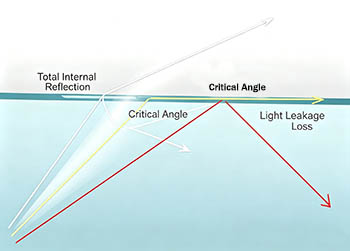
The illustration above demonstrates an optical phenomenon known as Total Internal Reflection (TIR).
Notice the red light beam. It hits the glass surface at a steep angle (incident angle), causing it to bounce back entirely into the glass. This is TIR in action.
Now, observe the yellow beam. It sits right at the "critical angle." If the incident angle is greater than this critical angle, light passes through the surface and escapes into the air. Why "partially or fully"? Because different wavelengths of light (ROYGBIV) have varying refractive indices. Conversely, if the angle is smaller than the critical angle, the light reflects completely without any loss. Binoculars utilize this property of glass to achieve the reflection needed for a properly oriented image.
BAK4 and BK7 are codes for different optical glass formulations. As mentioned, BAK4 has a higher refractive index than BK7. While BK7 is considered standard optical glass, BAK4 is a superior material used in high-grade Porro prism binoculars due to its performance and higher production cost.
To see this in action, grab a pair of Porro prism binoculars (large or compact, the principle is the same.
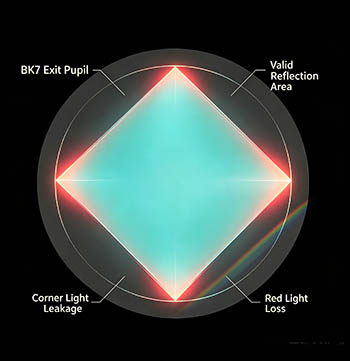
Hold the eyepieces about 16 inches (40 cm) away from your eyes and point them toward a bright, white background (like a wall). Look into the exit pupils. Do you notice a slight grayish or bluish tinted rim around the edges? If so, your binoculars likely use BK7 prisms, which are common in entry-level models.
What causes this "cut-off" effect? Refer to the diagram below.
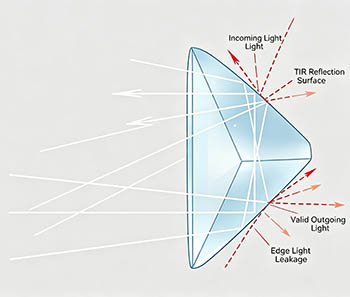
In the image above, you can see that BK7 has a lower refractive index. When light rays approach the critical angle, the red wavelengths tend to escape through the glass rather than reflecting back. Only the blue wavelengths are successfully reflected. This is why binoculars using BK7 prisms often show a darkened, sometimes purplish or brownish edge around the exit pupil. The result is not just a loss in overall brightness, but also a reduction in color fidelity, particularly in the reds.
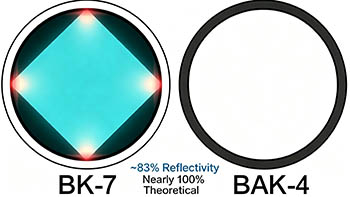
In comparison, a BAK4 prism reflects 100% of the incoming light (excluding absorption), whereas BK7 reflects roughly 83%. This gives BAK4 a significant advantage in light efficiency. Due to the higher cost of the raw material, BAK4 prisms are generally reserved for premium optical instruments where performance is the priority.
Summary:
① High-grade Porro prism binoculars typically utilize BAK4 prisms for superior optical performance.
② The primary benefit of BAK4 is a noticeable increase in brightness (often over 10%), resulting in a brighter, clearer field of view.
③ The easiest way to identify the prism material is to inspect the shape of the exit pupil. If you see dark, straight edges or a "cut-off" appearance, the binocular uses BK7. A perfectly round exit pupil usually indicates BAK4.
Comments
By J Pat Williams - 24/07/2026
Dude, this is so well-explained. Appreciate it!
Write a comment