
What Is the Diopter Adjustment Knob on Binoculars? (And Why You Absolutely Need It)
By Telescopehubs Optics - 24/07/2026 - 0 comments
If you’ve ever looked through a pair of binoculars and thought, “Why does my left eye look sharp but my right eye looks blurry?”—you’re not alone. The answer almost always lies in a small, often overlooked feature: the diopter adjustment knob.
In this quick Q&A, we’ll break down exactly what the diopter does, how to set it up correctly, and why skipping this step can ruin your viewing experience.
Q: What exactly is the diopter adjustment knob?
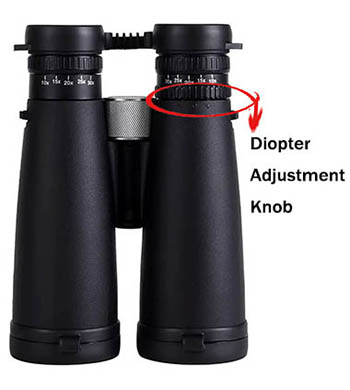
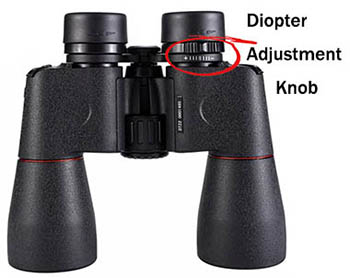
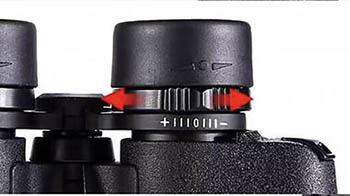
A: The diopter adjustment is a small dial or ring (usually marked with + / – signs and the word Diopter) located on the right eyepiece or sometimes near the center hinge of a binocular. Its job is to compensate for the difference in prescription between your two eyes.
While the main center focus wheel moves both barrels at the same time, the diopter knob independently fine-tunes the focus of one eyepiece—typically the right one. Think of it as a built-in corrective lens for that side.
Q: Why do I need it if I already have a focus wheel?
A: Because almost nobody has perfectly identical vision in both eyes. One eye might be slightly more nearsighted, farsighted, or have more astigmatism than the other.
The center focus wheel can only adjust both sides together. If your eyes aren’t matched, focusing for your left eye will leave your right eye slightly out of focus—and vice versa. The diopter makes up for that gap so both eyes see a crisp image at the same time.
Without it, your brain struggles to merge the two mismatched images, which leads to headaches, eye strain, and a loss of depth perception.
Q: How does the diopter actually work?
A: Internally, turning the diopter ring shifts the position of a lens group inside that eyepiece. This changes the optical path length and effectively adds or subtracts optical power—usually ranging from –5 to +5 diopters, which covers roughly up to 500 degrees of nearsightedness or farsightedness.
So if your left eye is –2.0 and your right eye is –3.5, you’d focus the binoculars for your left eye using the center wheel, then twist the right-side diopter to add that extra –1.5 correction for your right eye.
Q: How do I properly set the diopter on my binoculars?
A: Follow this simple 4-step process every time you use a new pair (or if someone else has used them):
-
Decide: glasses on or off. Pick one method and stick with it. If you wear glasses, you’ll typically set the diopter back to zero.
-
Close or cover your right eye. Use the center focus wheel to focus on a distant object until the image is perfectly sharp for your left eye.
-
Close or cover your left eye. Now, without touching the center focus wheel, rotate ONLY the diopter knob until the image is equally sharp for your right eye.
-
Open both eyes. Everything should now be crystal clear. From here on, use only the center focus wheel to adjust for near or far objects.
Once set, you rarely need to touch the diopter again—unless someone else borrows your binoculars.
Q: Where is the diopter knob usually located?
A: It depends on the type of binoculars:
-
Standard center-focus binoculars: Almost always on the right eyepiece. Some models let you pull the rubber eyecup up to reveal the diopter ring underneath.
-
Independent-focus binoculars: Common in military or marine models, these have separate focus rings on both eyepieces.
-
Monoculars or spotting scopes: These rarely have built-in diopters; you’d need aftermarket adapters.
-
Premium models: Often include a diopter lock to prevent accidental bumps once you’ve calibrated it.
Q: What are the most common mistakes people make?
A: Here are the big ones we see all the time:
|
Mistake |
Why It’s Wrong |
|---|---|
|
Confusing diopter with zoom/magnification |
Magnification is fixed by the optics; the diopter only adjusts focus for your eyesight. |
|
Only using the center wheel |
You’ll never get both eyes sharp if they have different prescriptions. |
|
Assuming glasses make the diopter unnecessary |
Glasses help, but you still need to zero out the diopter setting when wearing them. |
|
Never adjusting it at all |
Your brain compensates at first, but over time you’ll experience fatigue, headaches, and reduced 3D perception. |
Q: Any final tips for getting the most out of my binoculars?
A: Yes! Three quick ones:
-
Re-check your diopter seasonally. Your eyesight can change subtly over time.
-
Teach your family/friends. If they borrow your binoculars, show them how to reset the diopter for their own eyes—it takes 30 seconds and makes a world of difference.
-
Don’t cheap out on quality. A poorly designed diopter mechanism can slip during use, throwing off your hard-won calibration. Invest in binoculars with a solid, lockable diopter system.
Got questions about setting up your specific model? Drop us a comment below or reach out to our support team—we’re happy to help you dial it in! Also you can click here to Contact us .
Tags: Binoculars Guide, Optics Tutorial, Binocular Setup, Diopter Adjustment, Bird Watching Gear, Telescope Basics, Eyeglass Wearer Tips
Comments
Write a comment